.jpg)
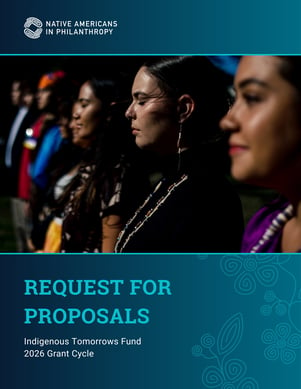 The Indigenous Tomorrows Fund (ITF) accepted applications May 20, 2026 – July 14, 2026.
Young people are cultivating thriving Native communities.
Over the last year, youth leaders between the ages of 14-24 have shared their dreams and visions for what thriving looks like in their communities. Through listening sessions, visioning sessions, and participatory design experiences, young people have tilled the soil of a beautiful community garden which will nourish future flourishing. Now, it is time to plant.
ITF will cultivate grant partnerships with Native-led and Native-serving organizations across the U.S. and its territories, giving away $1,650,000 total with all award decisions made by Native youth.
Who We Invite
We prioritize Native-led and Native-serving organizations and collectives whose work is accountable to Indigenous community. Applications are open to:
-
Native-led and Native-serving 501c3 organizations & collectives across the U.S. and its territories
-
Federally and state-recognized Tribal Nations, and their affiliated/sponsored/chartered entities and governmental programs or initiatives
-
Fiscally sponsored projects of a 501c3 organization that are Native-led and/or Native-serving
Strong applicants can locate their work within at least one of the five youth-named impact bundles, demonstrate how youth are involved in their work (especially those under 18), and understand their work as part of a larger ecosystem of community thriving.
Apply
Open: May 20, 2026 · Closed: July 14, 2026
Applicant Information Sessions: Thursday, May 28 at 3pm ET & Monday, June 22 at 2pm ET
Register for Information Sessions: Thursday, May 28 | Monday, June 22
JustFund Application Portal will be available on May 20, 2026 at nativephilanthropy.org/ITF
Questions about the Indigenous Tomorrows Fund: sbaber@nativephilanthropy.org.
What Grows in the Garden: Bundles of Community Thriving & Impact
These bundles are the focus areas of investment for the ITF 2026 grant cycle.
Youth leaders collaboratively identified dimensions of wellbeing that bundle together the unique strengths and challenges that Indigenous communities hold. These bundles are five expressions of an integrated community vision, and the inclusion of Native youth as leaders and participants in community life stands central throughout each of them.
Maintaining the Life Cycle of Balance — Cultural and spiritual infrastructure in community. Language, ceremony, artistic expression, and cultural access as a matter of sovereignty. Youth as culture carriers and as those whose identity is built through cultural participation.
Intergenerational Knowledge & Relationships — The weaving of youth, adults, and Elders as a living basket of culture, and a wellbeing intervention itself. Programs and practices where the relationship between generations is the work.
Healing — Holistic, culturally informed care that empowers the whole self. Physical, mental, and spiritual nourishment, alongside the conditions that shape wellbeing. Youth as those served and as participants in defining what healing looks like.
Nurturing That Which Nourishes Us — Indigenous foodways, lands, and waters as an interconnected system. Reclamation, maintenance, and protection of the environment that nourishes community. Youth as caretakers being trained in land-based knowledge and relationship, and as those whose rights to traditional food and lifeways are being protected.
Building Power & Activating Abundance — Sovereignty, civic identity, leadership, and the resources Native communities need to thrive. Youth as organizers and as the generation the power is being built for.
How We Plant the Garden: The Three Sisters
In a Three Sisters garden, squash, beans, and corn grow together because each does something the others cannot. Squash spreads close to the ground and shelters the soil. Beans climb what stands beside them and feed the soil in return. Corn grows tall and holds the architecture the others rely on. None of them thrives alone.
Applicants will be asked to identify as one of the Three Sisters, based on how their work actually grows across the youth-defined bundles of impact:
-
Squash — Specialized Work. Squash spreads close to the ground. Its broad leaves shade the soil, hold moisture in, and shelter the roots of everything else from heat and weeds. Without squash, the garden dries out.
Squash-zone organizations work close to the ground within a single bundle. Their work is specific, place-based, and rooted in one dimension of community life. They build the deep excellence the rest of the garden depends on — the focused, sustained work that protects what grows around it. Specialization is not a smaller ambition; it is the canopy that keeps the soil alive. Apply as squash if your theory of change lives within one bundle and your strength is depth in that single dimension.
EXAMPLE: A Community-Based Youth Wellness Hub- The Youth Wellness Hub is a youth-led initiative to provide fitness equipment to their community. Youth identified a specific barrier to their health and wellbeing and defined a solution to address it. The work is specific, place-based, and primarily relevant to the “Healing” bundle. Strong outcomes in this type of work, however, naturally impact the overall wellbeing of the whole system.
-
Beans — Intersectional Work. Beans climb. They reach toward what is already standing and find the structure that lets them grow upward. In return, beans return nitrogen back into the soil, feeding the very plants that hold them up. The relationship is reciprocal: beans need something to climb, and what they climb grows stronger because beans are there.
Beans-zone organizations work at the intersections of two or more bundles. Their work requires holding multiple dimensions together and moving them simultaneously, because moving any one alone would not produce the change the work is reaching for. Like the bean plant, this kind of work depends on what stands beside it and gives back to what supports it. Apply as beans if your work cannot be honestly described inside a single bundle, and if you can name the intersection your work holds in your own words and tell us what would be lost if either dimension were removed.
EXAMPLE: A Working Farm that Serves Systems-Impacted Youth- This working farm leverages the intersections of traditional land-based knowledge and foodways, healing, and maintaining cultural balance. Their work is strong, deep, and place-based with real outcomes for the youth that are served and developed. They have a wide community-impact, and the power of the work comes from the intersections they utilize.
- Corn — Systems-Level Movement. Corn grows tall. The stalk is the architecture other plants climb; corn holds the whole planting together by giving it shape. The garden depends on corn to provide structure for everything that needs to reach upward.
Corn-zone organizations — or community-initiated collaboratives of specialized organizations — hold the architecture of integrated community thriving. Their theory of change requires moving the whole ecosystem simultaneously, because the work is the system. Sometimes a single organization carries this scale; sometimes it is held by several specialized organizations growing together intentionally as one structure. Apply as corn if your work integrates multiple bundles as one interconnected system, and if your community recognizes you, or your collaborative, as holding that integrated architecture together.
EXAMPLE: A Holistic Youth-Driven Community Center- This community initiative holds the architecture of youth thriving for their community, integrating culture, wellness, power-building, traditional foods, and family services as an interconnected system. Their work requires an integrated systems-level approach to provide needed community infrastructure. They are modeling the system the youth in the community want and deserve.
Why the Three Sisters Grow Together
The Three Sisters are interdependent. That is the agricultural truth, and it is the strategic truth.
The ITF grantee cohort will be planted as a whole garden — squash, beans, and corn together — because that is how a harvest sustains a community. We are tending a balanced garden.
Tending Growth in the Garden: Three Grant Award Tiers
The grant tier describes the growth stage your work is in, independent of plant-zone. Any Sister may apply at any tier.
- Seed — $25,000. Newly planted. Community embeddedness is your primary strength.
- Sustain — $65,000. Rooted and bearing fruit. Communities already rely on you.
- Synergize — $100,000. Nourishing the whole garden. Your work moves community systems beyond itself.
What the Application Asks
The application asks you to do three things: tell us about your work through three questions, complete a supplemental budget template, and provide the standard organizational information requested by the JustFund platform.
The JustFund platform requires registration, and most accounts are approved within 24-48 hours.
Three questions, each response: 500–750 words :
- The work and where it lives in the garden. Identify which of the Three Sisters describes your work and how it moves one or more of the five bundles in Native communities. Which bundle or bundles does your work engage, and what specific results has it produced? How does your community recognize and respond to those results?
- Youth in the work. Young people have real authority in ITF because impacting youth thriving in Indigenous communities is the foundational purpose. Describe how the youth are a defining factor in your work — as leaders, participants, decision-makers, or those whose sustained wellbeing the work is designed to serve. What sustains youth participation, and what accountabilities exist to ensure youth voices influence how the work evolves?
- Ecosystem impact. ITF seeks to partner with organizations that understand interdependence, holistic community wellbeing, and how their work contributes to youth thriving in Indigenous communities. Describe how your work is accountable to and grounded in Indigenous communities. Who in the community is asking for this work to exist? How do you and your community define what success looks like for this work, and how do you know it's working — what do you notice, observe, or hear from your community that tells you the work is contributing to youth wellbeing in Indigenous communities? What information, support, or decision-making does your work depend on from community members or other organizations?
Budget, submitted with a provided template:
Grant tier- Seed, Sustain, or Synergize- is requested on a supplemental budget template that you will download, complete, and upload as part of your application. The template captures your funding tier request alongside a simple budget for how the grant would be used.
The budget template is available in the Request for Proposals and will also be included on the JustFund application platform.
.jpg?width=352&name=ITF-1%20(1).jpg)